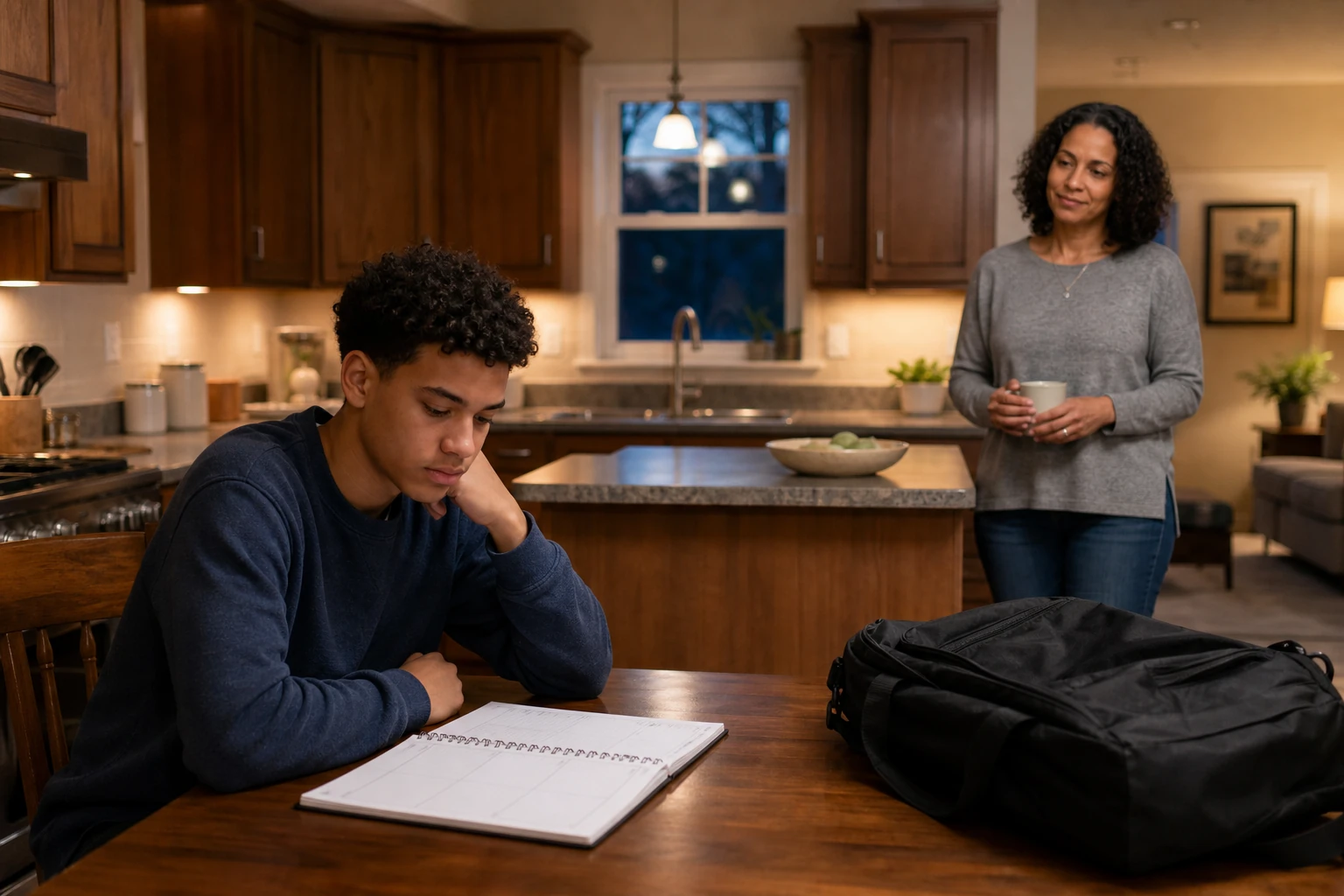
You finally stop stepping in.
Maybe you let him choose how to spend the money he has saved. Maybe you let him decide when to start a school task, pack his own sports bag, or work out how to get a form signed before the deadline.
Then it goes badly.
The thing is forgotten. The money disappears on something disappointing. The task becomes a late-night panic. You watch the consequence arrive and feel two things at once: I knew this would happen and I should have stopped it.
That moment can pull a family back into an old arrangement very quickly. The parent becomes the checker, rescuer, reminder, or detective. The teenager becomes the person whose responsibility is not really his because someone else will catch it at the last minute.
There is another option. For a mistake that is small enough to survive, you can let the consequence teach something without leaving your teen alone with shame.
The goal is not to let him fail for a lesson. The goal is to let him practise noticing, repairing, and making a better plan while you keep the line between a manageable mistake and a situation that needs an adult.
First, decide whether this is a practice mistake
A useful handoff is specific, age-appropriate, and reversible.
A manageable practice mistake might be:
- forgetting a non-essential item after agreeing to pack it;
- spending a small, pre-agreed amount badly;
- leaving a school task too late and having to explain the work honestly;
- choosing a poor sequence for chores, sport gear, or weekend plans;
- missing an agreed check-in and needing to repair the plan.
The likely consequence should be proportionate and repairable. He may feel disappointed, inconvenienced, or embarrassed. That is different from being unsafe, stranded, exposed, or unable to access something essential.
Do not turn this into a “natural consequence” experiment when there is immediate safety risk, alcohol or drugs, driving or dangerous transport, sexual-image sharing, coercion, violence, abuse, significant health needs, major financial exposure, or a legal or school-access problem. Those need adult involvement and a fuller plan.
A simple question can help:
“If I do not rescue this, will the likely result be safe enough, repairable enough, and useful enough for him to carry?”
If the answer is no, step in. That is not taking over. It is doing the adult part of the job.
Make the handoff clear before the mistake
A consequence is much easier to learn from when the responsibility was visible in the first place.
Before you hand over a task, name four things:
- What is his to manage?
- What support remains yours?
- What is the deadline or boundary?
- What happens if the plan does not work?
For example:
“You are in charge of bringing your sports gear on Saturday. I will get you to the field at 8:30, but I will not turn the car around for a forgotten bag. Put it by the door tonight if that helps.”
That is not a trap. You are giving the task, the available support, and the edge of the handoff in advance.
The CDC advises parents to involve older children in defining expectations and decisions, then listen as they think through the decisions and consequences afterwards. That does not mean handing over every decision. It means making room for a teenager to practise decisions that fit his current capability.
When it goes wrong, do less in the first ten minutes
The first ten minutes are often where a parent decides whether this becomes a repair or a power struggle.
Your teen may be angry, defensive, embarrassed, or suddenly eager for you to make the problem disappear. You may be tempted to teach the whole lesson while it is happening.
Try a shorter response first:
“This is rough. I can see you are disappointed. The plan did not work. We will talk about the next step when we are both calmer.”
That line does three useful things. It does not pretend the mistake is fine. It does not call him careless, lazy, or incapable. And it does not make you responsible for fixing every part of it immediately.
If there is a small practical action he can take, let him take it. He can tell the coach he forgot the gear. He can email the teacher honestly. He can use the money that remains to make a different choice. He can apologise to the person waiting for him.
You can stand nearby without becoming the spokesperson.
Use a repair conversation, not a post-mortem
Later, when the heat has dropped, try three questions:
- What happened?
- What did you expect would happen?
- What will you change next time?
Then listen long enough for him to think.
The answer may be imperfect. He may say, “I forgot,” or “I thought I had more time.” You do not need to force a grand insight. Help him get specific instead:
“What would make remembering easier next time?”
“What part can you set up tonight rather than hope to remember tomorrow?”
“Do you want a calendar reminder, a place by the door, or a five-minute check before you leave?”
The plan should belong to him as much as possible. Your role is to make sure there is a real next experiment, not to design his whole life for him.
A useful line is:
“I am not going to make you the problem because this went badly. I do want to know what you will do differently next time.”
Research on parental autonomy support links support for choice and perspective with better child wellbeing, while psychological control—such as shame, guilt, or withdrawal of affection—is linked with poorer wellbeing. That does not mean a parent must agree with every choice. It means the boundary can stay clear without turning a mistake into a verdict on the person who made it.
Keep the consequence; remove the extra punishment
A consequence works best when it is connected to what happened.
If he did not pack the gear, he may sit out part of practice. If he spent the small amount, he has less available until the next agreed amount. If he left a task late, he may need to own the conversation with the teacher.
Adding a second, unrelated punishment often changes the lesson. The focus moves from what can I repair? to how do I avoid getting in trouble?
That does not mean every consequence is hands-off. Parents still set rules, keep track, and follow through when a choice crosses a risk boundary. CDC guidance on parental monitoring is clear that expectations and responses to broken rules remain part of parenting through the teen years; they should adjust with maturity, not disappear.
Keep it proportionate. A forgotten lunch is not proof that your teen cannot be trusted with any responsibility. A repeated pattern is information that the handoff may be too large, the system may be weak, or another problem may need attention.
Step back in without taking the whole job back
Sometimes a first handoff exposes a gap. That is useful information.
You might say:
“This job is still yours. For the next week, I will do one check-in at 7:15 while you practise your new plan. On Friday, we will decide whether the check-in comes off.”
That is a scaffold: extra support with a purpose, a time limit, and a release point.
Avoid the silent reversal where you quietly return to reminders forever. If you need to add support, name what is changing and when you will review it.
Teen independence usually grows one decision at a time. Studies of adolescent decision-making suggest that autonomy develops differently across types of decisions, not as one all-or-nothing switch. Start with personal, low-stakes tasks. Use joint decisions where the choice affects safety, access, money, other people, or a family commitment.
Let the lesson be repair, not regret
The first time you let him handle something badly can feel like evidence that you let go too soon.
Sometimes it is evidence that the task needs a smaller handoff. Sometimes it is simply the first real practice he has had.
You do not have to rescue every disappointment to be a supportive parent. You do not have to turn every mistake into a lecture to be a responsible one.
Choose a responsibility small enough to survive. Make the boundary clear. Stay connected when the result is disappointing. Then help your teen make the next plan more workable than the last one.
That is how a mistake becomes practice—not because it felt good, but because he got to carry the repair.
PARENT ACTION
What to return to your teen
Practice Mistake: make a small handoff explicit, let the proportionate consequence land, run a calm repair conversation, then use a short scaffold only when needed.
PARENT GROWTH NOTE
One useful guide when it matters.
Get practical Parent Growth guides in your inbox. No noise, no pressure, and you can unsubscribe anytime.