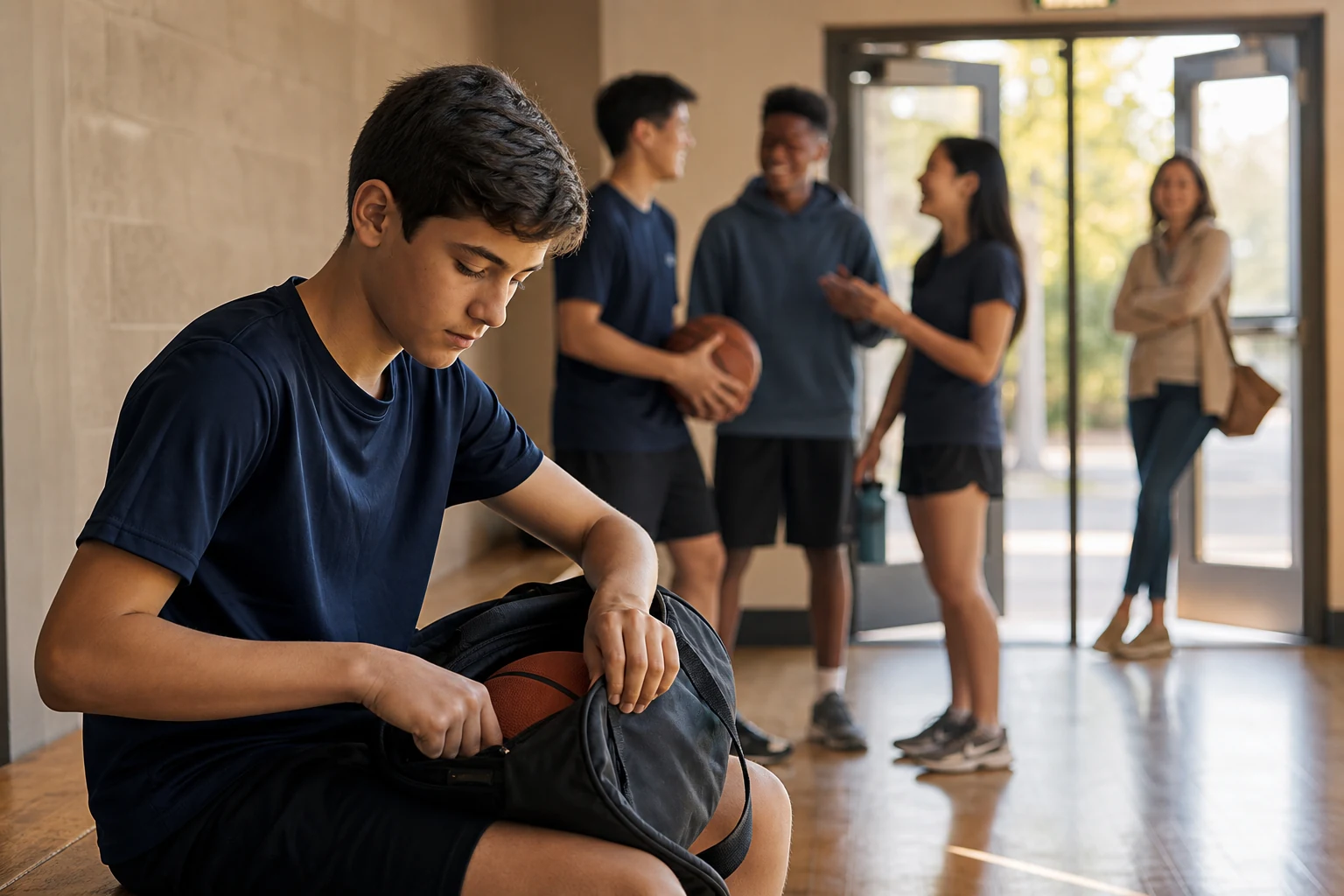
Your teenager shows up to practice every week. They run drills, listen to the coach, and do the work. After the whistle, other teammates laugh on the bench or walk out together. Your teen packs their bag and leaves.
At home they might say, “I just play and go,” or “It’s fine.”
You see them performing well but standing alone. You may worry they're missing out on the camaraderie, teamwork, and shared joy that makes youth sports meaningful—not just the competition. How do you help without turning sport into therapy or demanding friendships they do not want?
A quiet teen can enjoy the game and contribute to a team without being the heart of its social life. But it is reasonable to hope they have a real chance to feel known, trusted, and included in the shared work—not only to show up and perform.
This guide supports one narrow job: help your teen find one small teammate connection before, during, or after practice—without grilling, fixing, or diagnosing. It does not assume exclusion, anxiety, or a problem with the team. It preserves your teen’s autonomy to simply enjoy the sport while leaving the door open to more belonging if they want it.
Why your concern makes sense (and why it's not about "fixing" your teen)
When you watch from the sidelines, you are seeing a visible gap between what team sports can offer and what your teen appears to be accessing. A useful way to make sense of that gap is through three human needs often used to describe motivation in sport:
- Autonomy/choice – Feeling they have input and ownership in their participation
- Competence/contribution – Feeling capable, improving skills, and adding value to the team
- Relatedness/belonging – Feeling connected and valued by teammates and coaches
This is a lens, not a reading of your teen’s mind. They may be satisfied with the social side, or they may want more connection but not know how to move toward it. Either way, they do not need fixing. A low-pressure bridge can leave the social door open without taking away their choice.
Do not decide what the quietness means
A teen who arrives, plays, and leaves is doing the core job of a team sport: showing up and contributing.
They may:
- Enjoy the sport itself and not need the social layer
- Prefer to watch and listen before joining conversation
- Have different energy after intense physical activity
- Not yet know how to bridge from drills to casual talk
- Be content with a quiet role on a noisy team
- Need time to build trust before opening up socially
Or something else may be going on.
The first conversation should stay factual and low‑pressure:
“How was practice today?”
>
“Did you notice any moments where you felt connected to the team, or just separate?”
>
“Is there one person you'd feel okay saying a quick 'good practice' to?”
Avoid turning attendance into a character verdict:
- "You need to make more friends on the team."
- "Why don't you just talk to someone?"
- "They're obviously leaving you out."
- "You have to be more outgoing."
A parent can take the situation seriously without deciding what it proves.
A low‑pressure sequence: observe → one small connection → coach contact → step back
1. How to ask without grilling
Before the next practice, try one of these openers in the car or at home—not as an interrogation.
Option A (curiosity):
"I noticed you're really consistent with showing up and doing the work. Is there a part of practice you enjoy most?"
Option B (observation):
"Some teams chat a lot between drills; some are all business. What's your team like?"
Option C (simple check‑in):
"Anything you'd like me to know about how the team is going?"
If your teen says "It's fine" or shrugs, that's an answer. Say "Okay," and move on. You have planted the seed that you're paying attention, not demanding a report.
2. Help identify one small teammate connection
Pick one of these realistic connection points. Do not give your teen a list.
Before practice (arrival):
"When you walk in, pick one teammate and say 'Hey' or nod. That's it."
During practice (drill partner):
"If you get paired with someone, say 'Ready?' or 'Your turn.' Just the work talk."
During practice (sport-specific acknowledgment):
"When someone makes a good play, say 'Nice shot' or 'Good pass.' Keep it about the game."
After practice (leaving):
"On the way out, pick one person and say 'See you next time' or 'Good practice.'"
The goal is not friendship, eye contact, or a long conversation. It is one recognisable human acknowledgment from your teen to a teammate.
Rehearse it once at home if they're willing:
"Want to try saying 'See you next time' to me so it doesn't feel weird at practice?"
Stop after one try. You are making the words familiar, not grading performance.
3. Coach contact that asks for observation and inclusion opportunities
If several weeks pass and you see no change—and your teen seems consistently separate—consider contacting the coach once.
Do not:
- Demand friendship or social inclusion
- Diagnose shyness or anxiety
- Ask for special treatment
- Blame the team or coach
Do:
- Frame it as helping your teen access the full team experience
- Ask for the coach's observation
- Request small, practical inclusion opportunities
Email script (adapt to your voice):
"Hi Coach [Name],
>
I'm writing as a parent of [Teen's Name]. They really enjoy [sport] and are committed to showing up and doing the work.
>
I've noticed they tend to arrive, participate fully in drills, and leave without much casual interaction with teammates. I'm not asking for special treatment—just wondering if you've observed the same and whether there might be small, natural opportunities during practice where they could work briefly with a partner, be included in a quick team huddle, or have a clear role in a drill rotation.
>
If you have any observations or suggestions from your vantage point, I'd appreciate hearing them. Otherwise, no action needed.
>
Thanks for all you do with the team, [Your Name]"
This email:
- Respects the coach's role
- Keeps the focus on participation
- Avoids diagnosing or blaming
- Leaves room for the coach to notice or not
When you worry the team does not trust your teen in play
That worry makes sense, especially in team sports where passing, positioning, and communication matter. A teen can feel more like an outsider when teammates joke together off the field/court and, during play, they rarely look their way or involve them.
Do not decide the reason from the sideline. In sport, limited involvement can reflect:
- Position requirements – Different roles get different involvement
- Coach's system – Strategic plays may route through certain players
- Familiar pairings – Teammates who've played together longer naturally connect
- Fast decisions – In-game choices happen quickly, not personally
- Skill development – Coaches may be building confidence with simpler roles
- Team habits – Established patterns aren't necessarily about trust
Keep the first question concrete:
"When the play was developing, did you feel like you had a chance to call for the ball/puck or make a play?"
If they want help, rehearse one sport-specific contribution rather than "be more confident":
Sports with passing (soccer, basketball, hockey, etc.):
"I'm open." "Man on." "Nice pass." "One more."
Sports with positioning/formations:
"I've got left/right/center." "Switch." "Cover me."
Sports with individual contribution (track, swimming, etc.):
"Good race." "Well done." "Nice time."
These are work words, not forced socialising. A coach can also create natural practice reps: pairing different teammates, rotating small-sided groups, or asking each player to name a clear role. Ask for observation and opportunities—not a promise that teammates will pass more or become close friends.
Your hope is not too much. The useful version is: my teen deserves a fair chance to take part, build trust through repeated small actions, and enjoy the game. The part to release is a deadline for friendship, popularity, or a particular amount of attention from teammates.
4. When to step back
If after the coach contact your teen:
- Continues to attend and play
- Shows no distress about the social side
- Says they're fine with how things are
Then step back. Your teen has told you, through words or behaviour, that the current level of connection works for them.
Your job as a parent is to ensure they have access to belonging, not to manufacture a particular social experience.
The difference between quiet participation and a problem that needs support
Ordinary variation (no action needed beyond the steps above):
- Prefers to focus on the sport itself
- Enjoys teammates as co‑workers, not close friends
- Is quiet but not distressed
- Attends consistently and performs well
- Says they're "fine" and means it
Consider closer support (NIMH guidance) when behaviour or emotions:
- Last for weeks or longer
- Cause your teen distress
- Interfere with functioning at school, home, or with friends
- Make them want to quit a sport they used to enjoy
Seek urgent help now if your teen's behaviour is unsafe, or if they talk about wanting to hurt themselves or someone else. Contact local emergency services, a crisis service, or urgent health support immediately. The National Institute of Mental Health gives the same immediate-help boundary for unsafe behaviour or talk of harm to self or others.
Quiet participation on a team is not a warning sign. Lasting distress or functional impairment is.
A parent's checklist for the next two weeks
- Observe without diagnosing. Notice attendance, performance, and body language—not imagined internal states.
- Ask one open question before or after practice. Accept "fine" as a valid answer.
- Suggest one small connection point (arrival, drill partner, sport acknowledgment, leaving). Rehearse once if your teen is willing.
- Watch for two weeks. If nothing changes and your teen seems content, step back. If they seem persistently separate and you're concerned, consider the coach email.
- Preserve the sport. However the social side goes, protect your teen's enjoyment of the game itself. Performance and attendance alone are legitimate forms of belonging.
If your teen says, "I don't need friends on the team"
That is a clear boundary. Respect it.
You can reply:
"Okay. I just want to make sure you're getting what you need from the team experience. If that changes, let me know."
Then drop it. A teen who knows their own social preferences is exercising healthy autonomy.
The real goal: access, not assimilation
Your teen does not need to become the most social person on the team to belong.
They need:
- A reliable way to show up and contribute
- The option of small, low‑pressure connections
- Your support in accessing the full team experience
- Freedom to define what "belonging" means for them
Sometimes belonging is simply doing the work alongside others, week after week, without fanfare.
That is enough.
PARENT ACTION
What to return to your teen
Keep parent ownership of calm observation, access and proportionate coach follow-up while the teenager owns ordinary social timing, wording and whether to use a small connection step.
PARENT GROWTH NOTE
One useful guide when it matters.
Get practical Parent Growth guides in your inbox. No noise, no pressure, and you can unsubscribe anytime.