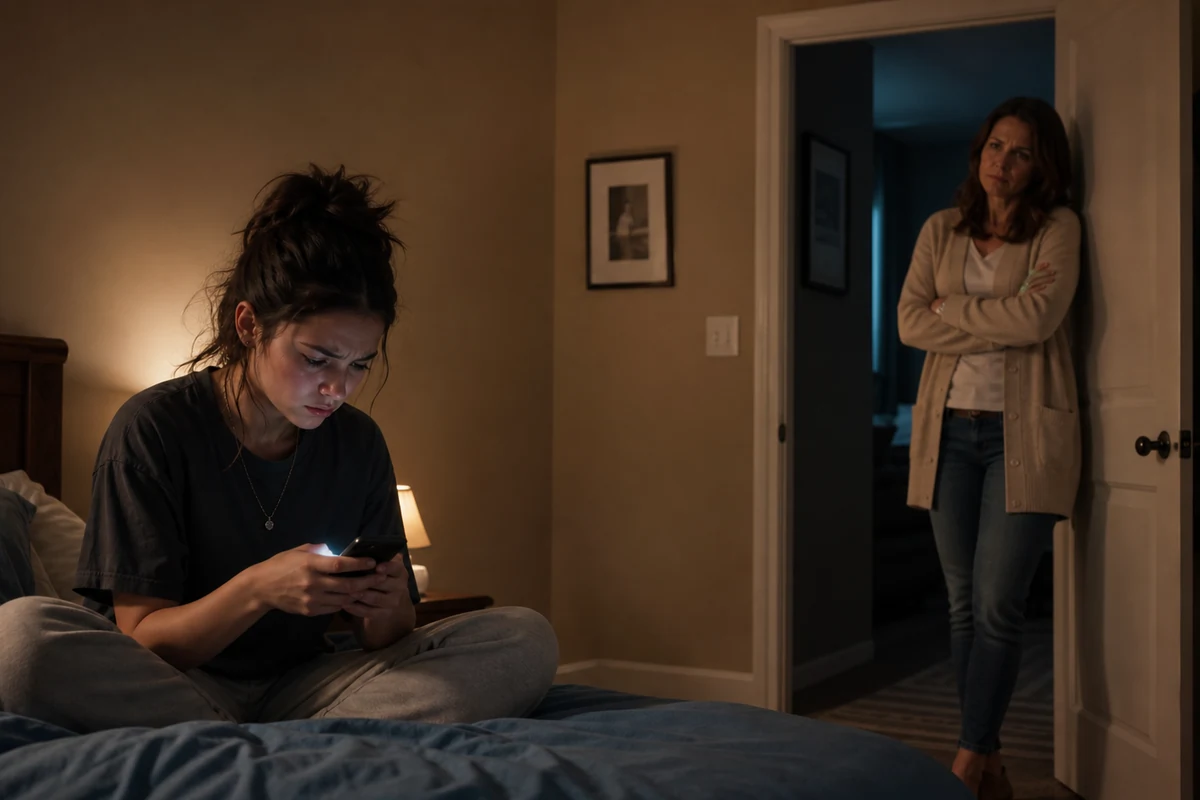
Your teen is typing with both thumbs. Fast.
A friend left them out. Someone said, “I heard what you said.” A teammate embarrassed them in the group chat. Now there is a furious paragraph waiting to go.
Try this before you reach for the phone:
“I can see you’re angry. I’m not asking for the whole chat. Before you send this version, can we check what it needs to do, what is fact, who might see it later, and whether any part needs adult help?”
For an ordinary angry message, use the ten quick checks below. Your teen can send, edit, switch channels, pause, or decide not to reply.
A better choice may remove some extra fuel. It cannot guarantee privacy, prevent a screenshot, control the reply, or stop conflict.
First: is this ordinary conflict or something bigger?
A rude reply or friendship argument may be your teen’s decision to work through. Some things are not.
An adult should take over when there is bullying/repeated targeting, discriminatory harassment, threats/weapons/violence, stalking, coercion/dating abuse, blackmail/sextortion, sexual images/non-consensual images, doxxing, hacking/impersonation/account compromise, abuse/neglect/exploitation, suicide/self-harm, serious medical danger, or immediate danger.
That means adult takeover, not leaving a teen to handle it alone.
- For immediate danger, get to safety if possible and contact local emergency help now. Serious medical danger also needs local emergency medical help and the instructions of the dispatcher or qualified medical staff.
- For suicide/self-harm, use these five steps: ask directly; listen and be present; help keep the person safe; connect them with trusted people, professionals, and local crisis support; follow up. A capable adult leads when a minor is involved.
- For abuse/neglect/exploitation, tell a safe adult and use the local child-protection or police reporting route. Do not investigate, confront the person, or promise secrecy that could leave someone in danger.
- For stalking, seek emergency help if danger is immediate. Save a log or evidence only when safe, use safer technology, and get local victim-service or police help with safety planning. Do not confront someone if that could raise the risk.
- For blackmail/sextortion or sexual images/non-consensual images, bring in a safe adult and the proper specialist, platform, child-protection, or police service. Do not bargain, pay, send more, forward, circulate, or download an image to keep as proof.
- When it is safe, save useful evidence before deleting or blocking. Do not stay exposed to collect more. Keep evidence private.
- For doxxing or hacking/impersonation/account compromise, check privacy settings, active sessions, recovery email and phone details, and change to a strong unique password. Use the platform’s account-recovery process and turn on multi-factor authentication (MFA).
Do not retaliate. No public pile-on, leaked screenshots, burner account, unsafe confrontation, or home-grown investigation.
A useful parent line is:
“You can own an ordinary reply. I will not leave threats, stalking, blackmail, sexual images, abuse, suicide danger, or immediate danger for you to carry alone.”
The SCREENSHOT check
SCREENSHOT is unvalidated Old Wisdom Retold guidance. It is not a clinical tool, treatment, legal guide, threat assessment, anti-bullying programme, or guarantee of safety. It simply gives a family a way to slow down one ordinary message and make a more deliberate choice.
S — STOP THE SEND
Move the thumb. Save the draft. Put the phone down for a moment if that is safe.
Your teen does not need to deny the anger or become perfectly calm. They only need to avoid sending the first hot version.
“I’m angry, and I’m not sending this version yet.”
There is no magic waiting time.
C — CHECK THE CROWD
Ask, “Who can see this now, and who could see it later?”
A private text can be copied, forwarded, cropped, or shown at school. Read the sharpest line by itself. Does it mean something different without the messages around it?
A screenshot can be useful evidence, but it may be incomplete, edited, or missing context. It is not the whole truth just because it looks convincing.
R — REASON
Give the message one job.
Is your teen asking what happened? Correcting a fact? Setting a boundary? Saying how something affected them? Ending the conversation?
If the real job is “hurt them back,” “embarrass them,” or “make everyone choose my side,” this version should not go.
E — EVIDENCE
Make two lines:
- What I know: the exact words, action, time, and people in the chat.
- What I’m guessing: the motive, secret audience, rumour source, or meaning of silence.
For example:
“I’m upset, but I don’t know the full story. What exactly did you hear, and from whom?”
Your teen does not have to prove another person’s motive before asking an adult for help.
E — EDIT THE HEAT
Keep one issue. Remove insults, threats, humiliation, sarcasm that hides the point, pile-on invitations, private screenshots, location details, passwords, and sexual or deeply personal material.
Before:
“You’re a lying fake and I’m posting everything.”
After:
“You told Maya I said ___. I didn’t. Please correct that, and don’t share our private messages.”
Direct is allowed. Cruel is not useful.
N — NARROW THE CHANNEL
Choose the smallest safe audience and a channel your teen can use well.
That might be one private text, a short note, a call later, an in-person talk if safe, a trusted adult, or no message at all.
Speaking is not always better than writing. Some teens think more clearly with a written draft, speech-to-text, AAC, extra processing time, simple wording, or a visual checklist.
S — SET A RETURN TIME
A pause needs an end point.
“I’m too angry to answer well. I’ll reply tomorrow after school.”
Or:
“I’m taking twenty minutes. Then I’ll decide if this needs one sentence or no reply.”
Do not use waiting as endless avoidance. A timely correction, clear boundary, safety report, or request for help may need to happen now.
H — HARM CHECK
Run the danger list again. If there may be bullying/repeated targeting, discriminatory harassment, threats/weapons/violence, stalking, coercion/dating abuse, blackmail/sextortion, sexual images/non-consensual images, doxxing, hacking/impersonation/account compromise, abuse/neglect/exploitation, suicide/self-harm, serious medical danger, or immediate danger, an adult takes the lead.
If you are unsure whether a threat is serious, do not make your teen prove it alone.
For ordinary drama, do not build a dossier. For real harm, save only what may be needed, safely and privately, before deleting or blocking. Never forward or download sexual material as “proof.”
O — OWN THE NEXT MOVE
The parent owns safety, reasonable home and device limits, account help, and getting the right adults or services involved.
The teen should increasingly own the ordinary choice: send, edit, change the channel, wait until a named time, or do not send. They also own their part of any repair.
Try:
“Do you want to read it aloud, show me only the draft, run the checks yourself, or ask me one question and decide?”
Help should not automatically cost your teen every private conversation. If you need a temporary device limit for safety or repeated harmful behaviour, explain why, protect safe communication and access needs, and set a review point.
T — TAKE REPAIR IF SENT
If the message has gone, stop adding more.
Correct any false claim. Name the hurtful line. Apologise for that part without demanding forgiveness. Remove or report a public post where possible. Your teen may ask the other person not to forward or to delete it, but cannot control their answer.
A simple repair sounds like this:
“That message was insulting. I was angry, but that doesn’t excuse it. The fact I needed to address was ___. I’m sorry for the attack. I’ll give you space.”
Repair does not guarantee forgiveness, deletion, or restored trust. The recipient does not owe comfort or reassurance.
Make it easier to use
Put the ten verbs in a phone note: STOP, CROWD, REASON, EVIDENCE, EDIT, NARROW, SET, HARM, OWN, REPAIR.
If ten steps feel like too much, use four boxes: FACT / PURPOSE / AUDIENCE / SAFETY. Ask one question at a time. Colour-code facts and guesses. Let your teen use speech-to-text and read it back, or show only the draft.
These are optional supports, not labels or diagnoses. Extra structure can make ownership easier, not take it away.
What this can look like at home
Your daughter has typed three screens after being left out of a sleepover. Her first draft lists every old grievance. SCREENSHOT helps her cut it to: “I felt hurt seeing the photos after you told me nothing was happening. Can you tell me what changed?”
Your son wants to answer a teammate’s insult in the team group. He chooses one private message instead: “Don’t call me that again.” It is direct and timely, without inviting the whole team into the fight.
Or your teen shows you a message threatening to share a sexual image. That is not a wording exercise. You take over the safety work, do not pay or bargain, and contact the proper service.
The aim is not a perfectly calm child or a perfectly safe sentence. It is a teen who can feel real anger, check the facts and audience, choose a useful next move, and hand adult-sized danger to adults.
A better pre-send choice may remove avoidable fuel. It cannot prevent screenshots, guarantee privacy, control another person, or stop conflict.
A small bridge to The War Playbook
The War Playbook gives teens optional practice in reading pressure before reacting, asking for facts, and weighing the cost of a fight. It is not a guide for bullying, sextortion, stalking, abuse, suicide, or emergencies. Adults and the proper services come first in those situations.
Research note
This article draws on a peer-reviewed review of adolescent decision-making, work on digital emotion regulation, and official or specialist guidance including NIMH's suicide-safety steps, Netsafe's sextortion guidance, Netsafe's image-based-abuse guidance, New Zealand Police guidance for parents/whānau responding to suspected abuse, and CISA's MFA guidance. Those sources support the linked safety routes, not the SCREENSHOT sequence or a promised result. Laws, services, and reporting routes differ by location. Full source links, access limits, and claim boundaries are recorded in the source audit for this article.
PARENT ACTION
What to return to your teen
Keep adult ownership of danger and account safety while returning ordinary send, edit, pause, channel and repair choices to the teenager.
PARENT GROWTH NOTE
One useful guide when it matters.
Get practical Parent Growth guides in your inbox. No noise, no pressure, and you can unsubscribe anytime.