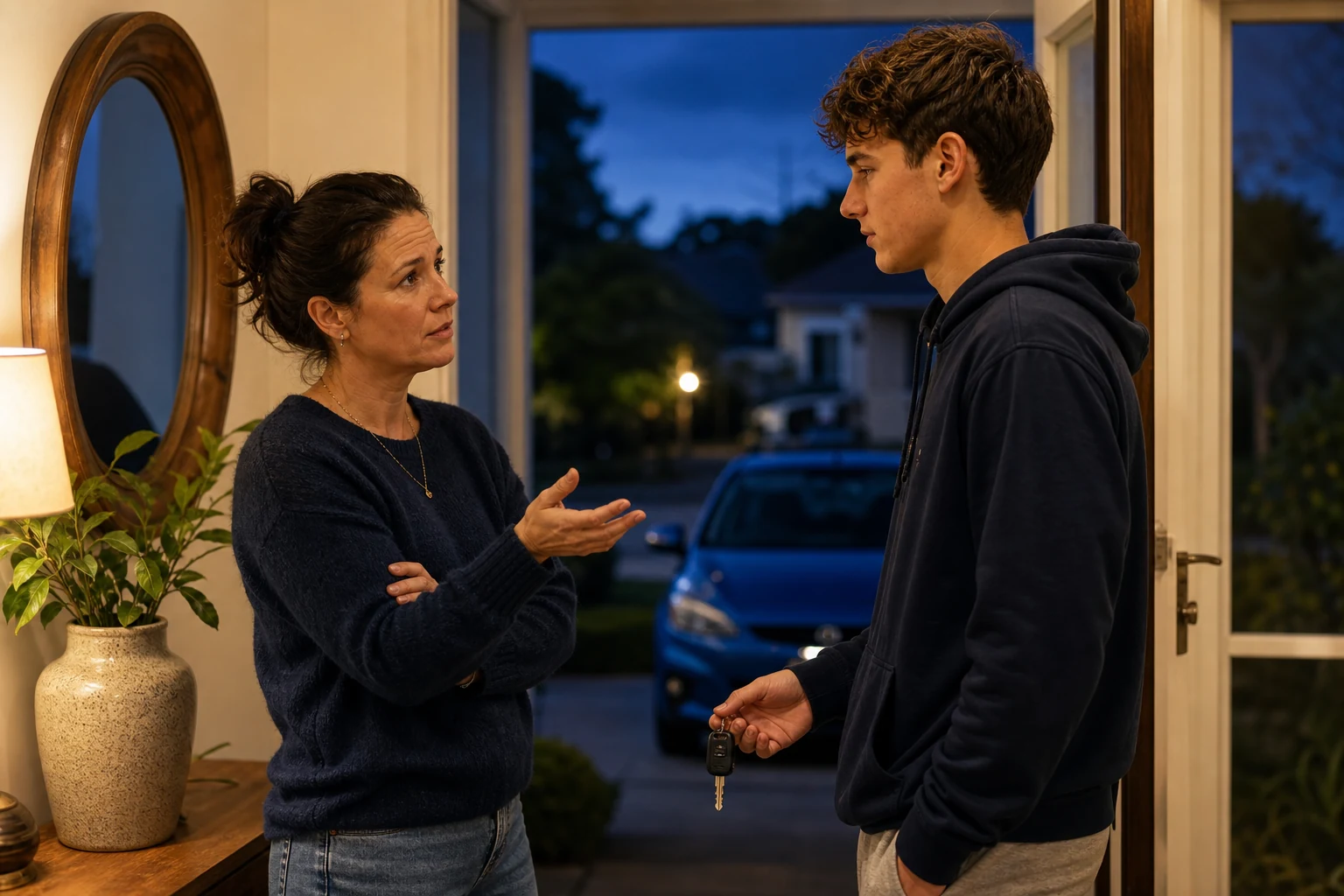
Your newly licensed teen is holding the car keys and saying, “The film ends at ten. Everyone else can stay.” You are thinking about dark roads, passengers and the phone call no parent wants. They are hearing, “You still do not trust me.”
There is no universal “right” driving-curfew hour. Licence stage, local law, experience, route, passengers, weather and fatigue all matter. Current local licence law is the floor, and parent permission cannot waive it.
For the next trip, do this: write down two separate times—the latest time your teen may be driving, and the time they must be home or at another approved safe place. Then name the backup ride if those times do not fit. This turns tonight’s argument into a plan without pretending every late drive is safe.
The one-minute plan
Before the keys move, agree on five things:
- Legal floor: licence conditions, passengers and driving window are lawful.
- Two times: the driving cut-off and home/approved-safe-place time.
- Trip facts: route, weather, vehicle, passengers and energy level.
- Safe exit: if anything changes, stop somewhere safe and call—help comes before the discussion.
- Review date: name the driving evidence and date that could expand one condition.
Put those five lines in a shared note. The detailed guide below helps your family make each one realistic.
The curfew question is really two questions
Parents often ask, “What is a reasonable curfew for a 16-year-old?” But one clock cannot do two different jobs.
1. The driving cut-off
This is the latest time your teen may be behind the wheel under the family plan. It must sit inside current licence law and reflect the conditions of this particular trip.
2. The social or household return time
This is when your teen must be home—or at another place you have agreed is safe.
The two times do not have to match. A concert may finish after your teen’s driving cut-off. That does not automatically mean missing the concert or extending the driving window. It may mean a parent, an eligible supervisor, an approved safe adult or another family-approved transport option handles the return.
Say it plainly:
“Your driving cut-off and your social return time are not always the same. If an event ends too late for you to drive legally or safely, we plan another ride. You never race home to beat the clock.”
That distinction matters because punctuality must never become a reason to speed, continue while exhausted or impaired, or accept a ride from an unsafe driver.
Trust is not the same as removing limits
Your teen may be dependable, thoughtful and doing well at school. Those qualities are worth noticing. They are not direct evidence that this driver is ready for a wet, unfamiliar road at night with passengers.
Grades, chores, a tidy room, politeness and general “good behaviour” should not buy a later driving window. In the same way, a poor grade or an argument about dishes is not evidence that someone has lost night-driving skill. Keep driving decisions attached to driving evidence:
- lawful trips;
- relevant supervised practice;
- seat-belt and phone-rule compliance;
- accurate route and passenger information;
- enough rest;
- updates sent while parked;
- no rushing to make a time;
- safe choices when plans or conditions change;
- willingness to call for help or abandon an unsafe drive.
Night driving, teen passengers, fatigue, distraction, impairment and inexperience are recognised danger areas for novice drivers. Graduated licensing uses narrower early exposure for that reason. But this does not mean one household clock has been proved safe for every teenager.
A fixed rule with no review path may also send a message you did not intend.
Your intent may be: I am protecting you while you gain experience.
Your teen may hear: Nothing I do will change your view of me.
You do not have to trade safety for trust. Give trust a visible review path while keeping law and non-negotiable safety rules in place.
A useful opening is:
“Driving gives you real independence, and it also puts you in conditions where inexperience matters. I do not want one permanent rule or a nightly argument. Let’s write the legal floor, the first driving window, what shows readiness for review, and what you do when the safe plan changes.”
Use TRUST for the next driving plan
TRUST—TRIP → RULES → UPDATE → SAFE EXIT → TRACK AND REVIEW—is Old Wisdom Retold (OWR) parent guidance. It is not a validated programme, legal test, driver assessment or crash-prevention guarantee. It does not replace current local law, insurance conditions, qualified instruction or supervised practice.
TRIP — define this drive, not just an hour
Before the keys move, name:
- destination, purpose and route;
- who will be in the vehicle and who may drive;
- the vehicle being used;
- weather, road and traffic conditions;
- the driver’s sleep, energy and ability to focus;
- the driving cut-off;
- the home or approved-safe-place time;
- the backup ride or safe place if the plan changes.
This is the teen’s chance to do more than ask, “Can I stay out later?” They can bring a real proposal:
“Here is the trip, route, passengers and return plan. Here is the legal condition I checked. If the event or weather changes, I will message while parked and use the backup ride.”
A parent still checks the current official licence rules. Researching them is useful teen ownership; deciding what the law says is not a household vote.
RULES — set the legal and safety floor
Some privileges can expand. The floor does not disappear on a good week.
Keep these rules clear:
- the trip, time and passengers must be legal for the teen’s current licence;
- everyone uses a seat belt;
- no driving after alcohol, drugs or any other impairment;
- no riding with an impaired or otherwise unsafe driver;
- no handheld calls, texts, map changes or updates while moving;
- no speeding, racing the clock or aggressive driving;
- no driving while dangerously tired or unable to focus;
- no unauthorised or unlawful passengers;
- no route, weather, road or vehicle condition beyond the teen’s current capability.
A full licence does not make every condition safe. Nor does an incident-free month prove that every trip was handled perfectly. Parents retain authority over access to the family vehicle, insurance obligations and immediate safety.
UPDATE — make a changed plan reportable
Plans change. A film runs late. Rain turns heavy. The agreed driver drinks. A passenger starts pressuring everyone. The car develops a warning light.
Agree in advance on the minimum useful update: where the teen is, what changed, whether the driver and vehicle are safe, and what help is needed. The message must be sent while parked, before the plan expires where possible.
“The plan changed. I am parked at [place]. I cannot make the agreed time without rushing / I am not safe to drive. I need [pickup / approved ride / permission to stay at the safe location].”
If communication fails, use the family’s pre-agreed contact sequence. Do not jump from “late update” to “reckless driving” before you know the facts. A dead phone, a safe decision to stop and deliberate deception are different problems and call for different responses.
SAFE EXIT — help first, discuss later
Your teen needs to know that meeting curfew is never the price of safety.
“If you have been drinking or using drugs, are too tired, feel unsafe, the driver is impaired, the weather turns, or the car has a problem: do not drive. Call me. I will help first and we will talk later. Being on time is never worth an unsafe drive.”
“No punishment at pickup” means calm transport and immediate safety first—no roadside lecture, interrogation or penalty for choosing the safe ride. This is an OWR safety-first household design, not a claim that it has a proven behavioural effect.
It is also not permanent immunity. Substance use, deception, unlawful conduct or a preventable planning failure can be addressed later, when everyone is safe. Keep the rescue decision and the accountability conversation separate.
TRACK AND REVIEW — expand one condition at a time
Before the trip, write down:
- the current rung;
- one proposed next privilege;
- the driving evidence that will be considered;
- a review date or number of relevant practice trips;
- the linked step-down if a condition is missed;
- what restores eligibility for another review.
Where practical, change one variable at a time—time, route, distance or passenger privilege—rather than expanding everything together. A review is not an automatic promotion. The answer can be “expand one condition,” “hold this rung,” or “get more supervised practice first.”
An illustrative driving trust ladder
This ladder contains no universal fixed hours because the lawful and sensible window varies. Check your current local licensing authority before filling in your family’s plan.
| Rung | Possible privilege—only where legal | Relevant evidence before review | Review response | |---|---|---|---| | 0 — Supervised conditions | Night, rain, unfamiliar routes or complex roads only with an eligible supervisor | Coached practice; correct decisions about hazards, focus and fatigue | Repeat relevant practice or consider a narrow solo condition | | 1 — Narrow solo | Familiar route, daylight or early evening, no peer passengers | Lawful trips, parked updates, belts and phone rules, calm planning, no rushing | Hold, step down briefly or review one next condition after the stated date/trip count | | 2 — Bounded later trip | One familiar destination with a slightly later driving window | Relevant night practice, adequate rest, safe route and weather, lawful passenger status, a backup ride | Expand one condition, hold, or return to supervision for the weak condition | | 3 — Broader planning ownership | Teen proposes the route, legal check, transport backup and update plan | Consistent planning and willingness to stop, change rides or abandon an unsafe drive | Release more planning ownership while keeping the legal and safety floor |
The hours on a family ladder can never override law. For example, official New Zealand guidance restricts unsupervised driving for restricted-licence drivers between 10 p.m. and 5 a.m. Other places and licence stages differ. Use that example as a reminder to check—not as a timetable to copy.
When a condition is missed, link the consequence to driving
A useful consequence is:
- related: it changes a driving condition rather than humiliating the teen or taking away something unrelated;
- specific: it names the time, route, passenger or supervision change;
- proportionate: it distinguishes a late but safe choice from speeding, impairment, deception or unlawful passengers;
- reviewable: it says how long the step-down lasts, what practice is needed and when you will review it;
- safe-exit compatible: it never makes driving unsafely the easier way to avoid trouble.
For example, a missed parked update may lead to a shorter window and a repaired check-in plan. Struggling on an unfamiliar night route may mean supervised practice on that route. Speeding, impaired driving or unlawful passengers can justify a firmer and longer restriction, loss of vehicle access, and professional or legal involvement where appropriate.
Use observable facts rather than a verdict about character:
“You are home safely; that comes first. The agreement was missed because [observable fact]. For the next [stated period or trips], solo night driving steps back to [specific condition]. We will add [relevant supervised practice or planning repair] and review on [date]. The call-for-help promise still stands.”
Ask yourself:
“Am I responding to driving evidence—or using the car to reward or punish something unrelated?”
Rehearse the branches before they happen
A good plan covers more than lateness. Discuss these branches while everyone is calm.
Impairment, fatigue, pressure or an unsafe driver
Do not drive or keep driving after alcohol or drugs, when dangerously tired or unable to focus, when frightened or coerced, or when the proposed driver is impaired or unsafe. Do not accept an unsafe ride to meet the household clock. Use the backup ride, remain at an approved safe location, or contact a parent or approved adult.
Passengers and distraction
Passenger rules must follow current licence law and the family plan. If passengers become disruptive, pressure the driver, remove seat belts or create an unsafe situation, the driver should not continue as though nothing changed. Stop where lawful and safe, then use the agreed adult-help plan. Never handle a phone or send an update while moving.
Weather or road conditions
Check official local weather and road information before leaving. If conditions worsen beyond the teen’s experience or the vehicle’s safe capability, delay, reroute, stop or abandon the drive as local official guidance requires. Never drive through floodwater or ignore a road closure to make curfew.
Vehicle trouble or breakdown
If the vehicle can be moved safely and local rules allow it, stop in a safe place, use the vehicle’s hazard lights and call for help. If moving or leaving the vehicle would create more danger, follow local roadside or emergency instructions. Road position, whether to remain inside and other detailed steps depend on the road, traffic and local law.
Crash, injury, medical problem or active threat
For a crash involving injury, immediate danger or another medical emergency, contact local emergency services and follow dispatcher and official instructions. Handle a non-emergency crash from a safe position according to current local police, reporting, insurance and roadside instructions. Do not improvise treatment from an article or put yourself into moving traffic or another unsafe scene. For a non-emergency medical condition that could affect driving, stop driving and seek appropriate local medical guidance before resuming.
These branches are not ordinary curfew negotiations. Immediate safety takes priority, and local emergency, roadside, medical and licensing authorities take over where the family’s capability ends.
What you are trying to build
The short-term goal is a safe plan for tonight. The longer-term goal is a young driver who can read conditions, obey the law, plan a backup, communicate while parked, refuse an unsafe drive and accept a proportionate consequence.
That changes who owns what.
The parent owns: access to the family vehicle, the legal and safety floor, transport rescue, proportionate driving-related consequences and the timing of reviews.
The teen increasingly owns: checking the trip conditions, proposing the route and backup, giving parked updates, choosing not to drive, accepting linked consequences and bringing relevant evidence for the next review.
Licensing authorities and qualified instructors own: licence requirements, official legal guidance, professional instruction and formal driver assessment.
Release planning a step at a time. Do not release legal responsibility, and do not pretend risk has disappeared.
Try this before the next evening trip
- Check the teen’s current licence conditions on the official local authority website.
- Write the driving cut-off and social/home time as two separate lines.
- Fill in one current ladder rung—without copying a universal hour.
- Name the route, passengers, weather check, fatigue check and backup transport.
- Rehearse the parked-update and safe-exit scripts once.
- Set a review date and choose one piece of relevant driving evidence.
- Write one linked consequence before emotions are running high.
Then ask the bigger question: Am I only trying to get my teenager home on time, or am I building a driver who knows when not to drive?
Optional practice for the teen
The War Playbook gives teens optional practice in reading conditions, protecting the next move and choosing a clean exit under pressure. It is not driver training or a licence guide; local law, supervised practice and a family driving plan come first.
Sources
- CDC: Reducing Risk for Teen Drivers — novice-driver risk, graduated licensing and a meta-analysis of 14 studies. GDL was associated with about 19% fewer injury crashes and 21% fewer fatal crashes among 16-year-olds; these are policy-system associations, not effects of a household curfew or OWR’s ladder.
- CDC: Eight Danger Zones for Teen Drivers — inexperience, passengers, night driving, seat belts, distraction, drowsiness, reckless driving and impairment.
- CDC: Parent–Teen Driving Agreement — a practical official tool for writing and reviewing expectations; a written agreement is guidance, not a guarantee.
- NHTSA: Teen Driving — US official guidance on graduated licensing, nighttime driving, passengers, distraction and impairment. Expert guidance is not proof that a particular household plan works. Use your own jurisdiction’s official rules.
- Fell, Todd and Voas: “A National Evaluation of the Nighttime and Passenger Restriction Components of Graduated Driver Licensing” — nighttime restrictions were associated with an estimated 10% reduction in 16–17-year-old driver involvement in nighttime fatal crashes; this was a US state-panel FARS policy study, not an individual household-curfew trial.
- Simons-Morton and colleagues’ Checkpoints randomized trial — six-month report and 12-month report — follows the same 3,743 Connecticut families, not independent samples. At six months, limits increased modestly but reported risky driving, violations and crashes did not differ. The later report found greater limits plus some teen-reported risky-driving and violation differences, but no crash effect.
- Hamann and colleagues: parent–teen driving expectations — a cross-sectional study of 163 predominantly White Iowa parent–teen pairs found low agreement on several expected driving conditions; it does not show that disagreement causes crashes.
- NZ Transport Agency Waka Kotahi: restricted-driver guidance and breakdown guidance — location-specific examples; check the current official authority where you live.
- US National Weather Service: flood-driving safety, MedlinePlus: recognising medical emergencies and American Red Cross: Check, Call, Care — use current local weather, roadside, medical and emergency instructions for your situation.
PARENT ACTION
What to return to your teen
Keep law, vehicle access, and immediate safety with the parent while gradually transferring trip proposals, parked updates, safe non-driving decisions, and review evidence to the teen.
PARENT GROWTH NOTE
One useful guide when it matters.
Get practical Parent Growth guides in your inbox. No noise, no pressure, and you can unsubscribe anytime.