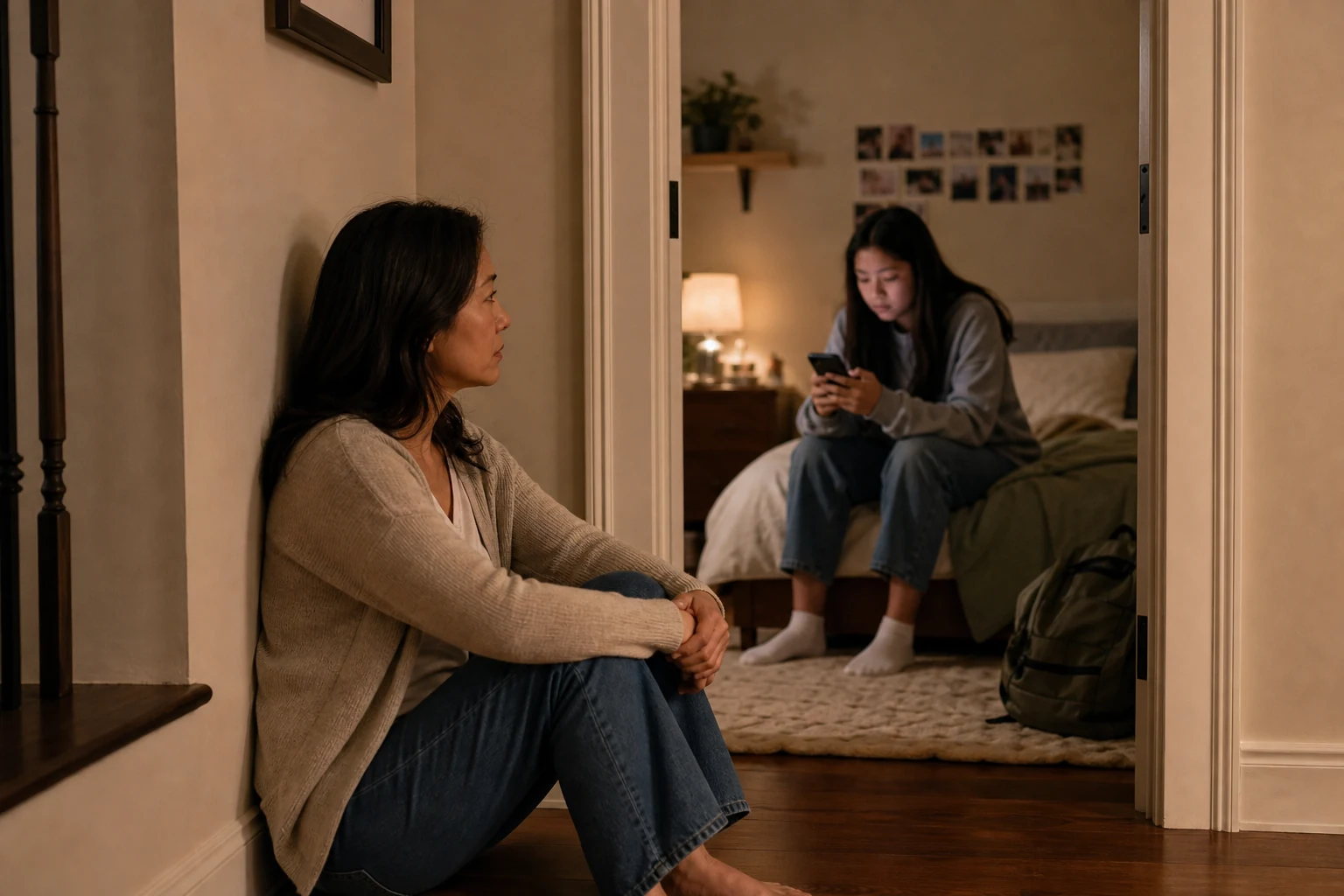
It is 12:18 a.m. Your teen’s phone keeps lighting up. They say, “I can’t go to sleep. What if my friend does something?” You are worried about the friend—and about your child, who is starting to feel responsible for keeping another young person safe.
Start here: stay calm, ask what the messages actually say, and bring in a safe, capable adult when the need is beyond ordinary friendship. Do not begin by calling the friend toxic or ordering your teen to end the friendship.
Safety comes first. If there is credible talk of suicide or self-harm, abuse or neglect, violence or coercion, an overdose or serious medical danger, or any immediate danger, skip ordinary friendship advice. Get a responsible adult and local emergency, crisis or child-protection service involved now. Do not leave your teen as the only responder, and do not promise secrecy. This action is supported by guidance from NIMH on suicide risk, NSPCC on abuse disclosures, NHS on poisoning and overdose danger, official emergency guidance on violence and immediate danger, and Oranga Tamariki on child-protection concerns. Use the services and emergency numbers for your location.
This article is about what to do after distress has reached your teen. It is not a test of whether the friend is a “good” or “bad” person. The useful question is: what can a caring peer reasonably carry, and what belongs with responsible adults and professionals?
Notice the load, not a label
A friend can have a terrible week and need more support than usual. Friendship is not perfectly equal every day. A breakup, bereavement, family problem or frightening event can create a temporary imbalance without making either young person a bad friend.
Look instead at what is happening in your home:
- Is your teen losing sleep to late-night calls or messages?
- Are they checking the phone in class or abandoning homework and plans?
- Do they believe a delayed reply could cause something terrible?
- Does the friend say, “You’re the only one,” or “Don’t tell anyone”?
- Are safe, capable adults already involved?
- Is there a specific statement or event that suggests danger?
Repeated urgency and pressure can crowd out sleep, school, mood and ordinary life. That describes an effect; it does not prove manipulation, a diagnosis or a motive.
Your teen may feel burdened and genuinely close to this friend. That is another reason to notice the load without rushing to judge the friendship.
Four different situations need four different responses
Busy nights ease when you separate them.
1. Ordinary friend support
A friend has had a difficult day and wants to talk. Your teen can listen for a while, ask what would help, suggest one next step and follow up later. Heavy feelings alone are not an emergency.
2. The peer role is becoming too large
Contact is repeatedly urgent or disruptive. Your teen feels unable to sleep, study, see other friends or put down the phone. The answer is not a diagnosis or an automatic friendship ban. It is to widen the support circle and set limits on your teen’s own availability.
3. A dangerous secret
The friend mentions suicide, self-harm, abuse, neglect, violence, coercion, exploitation, overdose, a serious medical problem or immediate danger—and asks your teen not to tell. Privacy no longer means keeping the danger between two young people. Share only what a capable helper needs, but bring in help.
4. An immediate emergency
An attempt or imminent suicidal intent, serious injury, overdose, unresponsiveness, severe bleeding or breathing difficulty, an active weapon or threat, ongoing violence, or another immediate danger needs emergency action now. Do not wait to finish a conversation framework.
A boundary is different from all four. It is a truthful limit on your teen’s own time, channel or action: “I won’t see messages while I’m asleep.” It is not a threat meant to control the other person.
Why taking over can make this harder
Your wish to protect both young people is reasonable. But “That friend is using you; you’re never speaking to them again” can land very differently from how you mean it.
Your intent may be: I need to stop this swallowing you.
Your teen may hear: You think my loyalty is stupid, and I cannot tell you anything without losing my friend.
That does not mean parents should stand back from danger. It means matching your authority to the real job. A friendship ban, blanket message search or direct confrontation may give you short-term control while encouraging secrecy. At the other extreme, saying “Stay out of it” can leave a teenager deciding alone whether a life-or-death statement is real.
The longer-term capability is neither obedience nor rescue. It is judgment: care humanely, notice when a peer role has reached its limit, get capable help, and hold a boundary without cruelty.
Open the conversation this way:
“I’m glad you care about your friend. I’ve noticed the late-night messages are costing you sleep and you seem responsible for keeping them okay. I’m not asking you to drop the friendship. I want to help you care without being the only person holding this.”
Then separate ordinary privacy from danger:
“You do not have to show me every message or tell me every private detail. I do need to know whether anyone has mentioned suicide, self-harm, abuse, violence, an overdose, a serious medical problem, or being in immediate danger. Those are not secrets a teenager should have to carry alone.”
If your teen fears betraying their friend, say:
“Telling a safe adult about danger is not gossip and it is not punishment. We will share only what the responsible person needs to help, and we will not turn it into a public story.”
CARE → CHECK → CONNECT → STEP BACK
CARE → CHECK → CONNECT → STEP BACK is an Old Wisdom Retold guidance practice. It is not a treatment, a clinical risk tool or a guarantee. A teenager is using it to open a route to help—not to assess, treat or monitor a crisis alone.
CARE — respond like a friend
Start with humane attention, not diagnosis or instant fixing:
“That sounds really heavy. I’m glad you told me.”
“Do you want me to listen for a few minutes, help think of one next step, or help you reach someone?”
For ordinary support, your teen can make the limit part of the kindness:
“That sounds rough. I can listen for ten minutes. Do you want listening, one idea, or help contacting someone?”
Think of this like holding a door open. A friend can help someone reach the next safe place; they do not have to become the whole building.
CHECK — ask about safety and capacity separately
If a message suggests self-harm or suicide, plain words are safer than hints:
“Are you thinking about hurting yourself or suicide?”
“Are you in danger right now?”
NIMH guidance says asking directly about suicide does not increase suicidal thoughts or behaviour. Your teen is not expected to decide how serious the risk is alone. A “yes,” uncertainty in the face of credible danger, or a worrying message they cannot safely evaluate means getting an adult or service involved.
Capacity is a separate question:
“Can I safely stay in this conversation now, or do I need another person involved?”
Capacity can shape an ordinary limit. It can never be used to downgrade danger.
CONNECT — widen the circle
Your teen can say:
“I care about you, but I can’t be the only person who knows or the only person helping. Let’s choose an adult who can support you too.”
Or:
“I care about you, and this needs more support than I can give alone. Let’s contact a safe adult now.”
A useful adult is not simply familiar. They must be safe, reachable and able to act. That might be a parent or caregiver when safe, school counsellor, teacher, coach, doctor or clinician, youth worker, crisis service, child-protection service or emergency service. If home or a caregiver may be the source of danger, choose someone else.
“Just tell an adult” may not be enough. Help your teen choose someone safe and able to act, then explain what will happen next.
When danger cannot remain private, your teen can say:
“I know you asked me not to tell. Because you might not be safe, I can’t keep this only between us. I’m getting a safe adult to help now. I’ll stay with you while we contact them if I can do that safely.”
A choice can make connection easier without making safety optional:
“You can tell them, I can sit with you while you tell them, or I can tell them. I can’t keep a safety risk secret.”
STEP BACK — from rescue, not care
Once capable help is involved and there is no immediate emergency, your teen can leave the sole-responder role.
“I care about you. I can’t talk tonight, and I won’t see messages while I’m asleep. Please contact another person you trust. I’ll check in tomorrow after school.”
“I’m not able to be on call overnight. I’ll check in tomorrow after school.”
“I care about you. I can listen for ten minutes, but I can’t be your only support or keep missing sleep.”
If the friend responds with guilt or pressure:
“I’m not leaving because I don’t care. I’m saying what I can safely do. I can talk tomorrow, and I need another adult involved if you are not safe.”
Stepping back can mean muting the chat, sleeping, attending class, seeing other friends and enjoying ordinary life. A kind check-in tomorrow can preserve connection. Step back does not mean ghosting during immediate danger, punishing disclosure, spreading private messages or withdrawing affection to force a result.
The safety bypass—again, because it cannot wait
Do not work through the four steps when there is credible immediate self-harm or suicide risk, abuse or neglect, violence or coercion, overdose or serious medical danger, or any other immediate danger. Contact a responsible adult and the appropriate local emergency, crisis or child-protection service now. If it is safe, stay with the person or maintain contact while help is being engaged. Do not leave a peer as the only responder. Do not promise secrecy or wait for the friend’s permission.
Do not ask either teen to investigate abuse, confront an alleged abuser, physically intervene in violence, transport an unsafe or intoxicated person alone, or remove weapons or medication if that could put them at risk. Follow instructions from local emergency professionals. Preserve relevant messages, but do not forward them around the friendship group. These actions align with suicide-prevention guidance from NIMH, first-aid guidance for severe bleeding and unresponsiveness, official child-protection reporting guidance, and official guidance on immediate police emergencies. The linked services use country-specific systems; use the equivalent services where you live.
Tell your teen:
“This is not something you have to judge or carry alone. We are getting responsible help now. Your friend may be angry that an adult knows; safety matters more than keeping this secret.”
When contacting a capable adult or service, stick to observable facts:
“My teenager received messages that make us concerned this young person may be unsafe. The words/actions we have are: [brief observable facts]. We have not tried to diagnose or investigate. What is the safest next step, and what should we do while help is arranged?”
Afterwards, your teen may feel relieved, guilty, angry or frightened:
“You did not cause this, and you are not responsible for fixing it. You did the caring thing by bringing in someone able to help. We can expect mixed feelings without handing the crisis back to you.”
What the parent owns—and what the teen can own
You still have authority. You may protect sleep, school, transport, money, visitors, device routines and safety in your home. Attach the limit to what you can observe, not to a verdict about the friend.
“Phones charge outside bedrooms after eleven. If a message suggests danger, wake me; you do not handle it alone.”
“I will help contact a safe adult. I will not have you drive alone to a possibly violent or intoxicated situation.”
You own safeguarding action and household limits. Qualified adults and services own clinical assessment, crisis care and safeguarding investigation. Your teen can own an age-appropriate boundary, ordinary reply timing, a later check-in and—once safety responsibility is shared—the choice of how to continue the friendship.
The larger question is: “What am I helping my teenager learn to carry, share and release?” You are building kindness without total responsibility.
Try this tonight
If there is no immediate danger:
- Describe one observable effect: “The calls have woken you three nights this week.”
- Ask the privacy-versus-danger question.
- Choose one safe, capable adult your teen could contact.
- Rehearse one sentence—ordinary support, widening support or delayed availability.
- Agree on one household limit and one way your teen can wake or reach you if danger appears.
- Let your teen deliver the ordinary boundary where they safely can. Review what happened later without demanding the friendship end.
Care can remain personal. Crisis responsibility must become shared.
Optional practice for the teen
The Social Playbook can give a teenager more language for empathy, boundaries and reading relationship roles. It is optional practice—not a crisis manual. When safety is at stake, use responsible adults and local professional or emergency support.
Sources
- National Institute of Mental Health: 5 Action Steps to Help Someone Having Thoughts of Suicide
- Youth – 988 Lifeline (US service; use local services elsewhere)
- YoungMinds: Supporting a friend with their mental health
- NSPCC: What to do if a child reveals abuse
- NHS: Poisoning and First aid
- New Zealand Police: Emergency guidance and Oranga Tamariki: Reporting concern about a child (use local equivalents)
- Spendelow, Simonds and Avery: co-rumination review — association does not establish causation.
- Starr and Davila: co-rumination and friendship study — a small girls-only sample; not universal evidence.
- Campos-Castillo and colleagues: adolescents choosing trusted adults — a small qualitative sample; not universal behaviour.
PARENT ACTION
What to return to your teen
After safety responsibility is shared with capable help, let the teenager choose and deliver an age-appropriate boundary, ordinary reply timing, and how to continue the friendship.
PARENT GROWTH NOTE
One useful guide when it matters.
Get practical Parent Growth guides in your inbox. No noise, no pressure, and you can unsubscribe anytime.