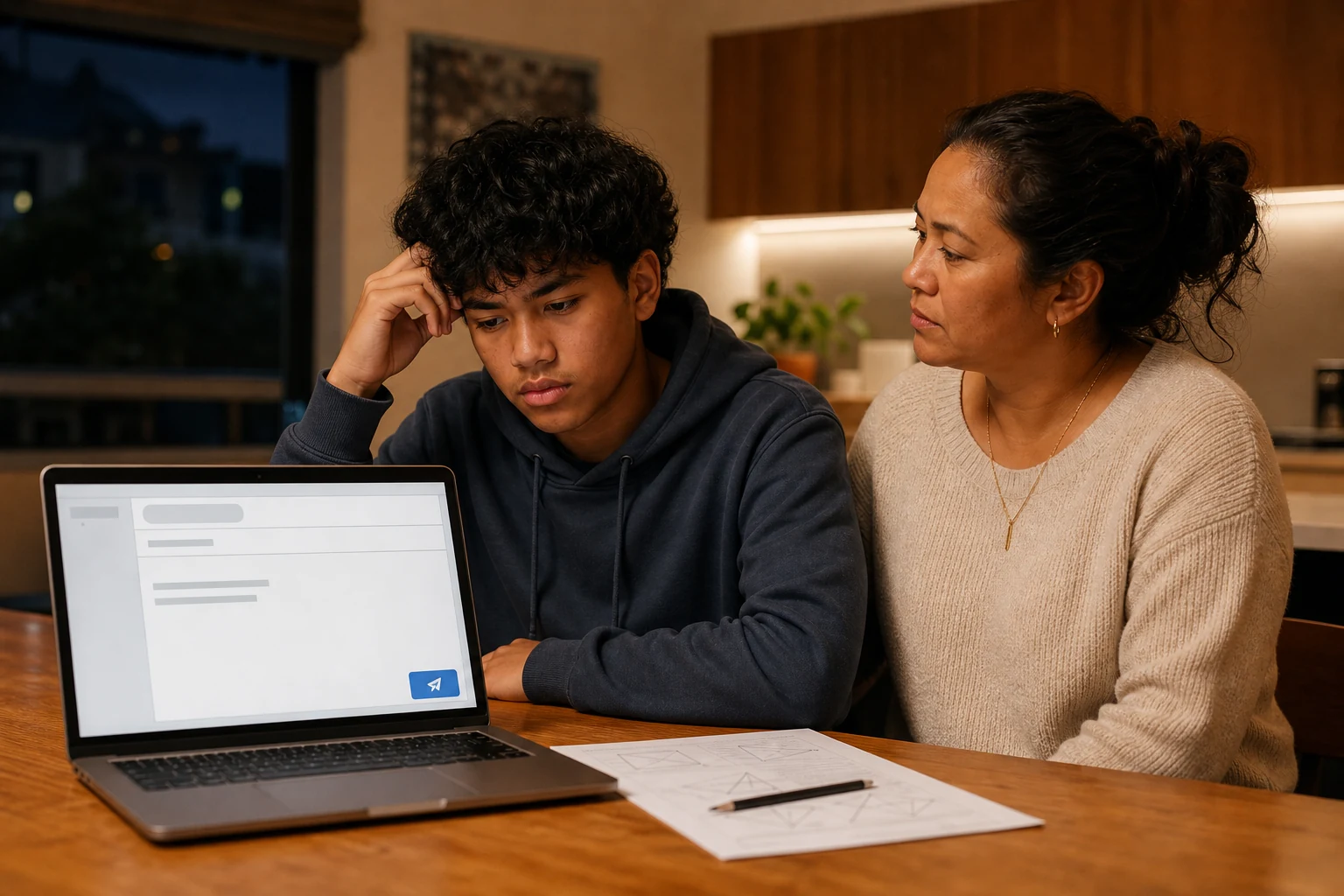
Turn “ask your teacher” into one private, specific request your teen can own—without taking over when the issue is still a routine assignment question.
Your teen says the assignment makes no sense. You say, “Ask your teacher.” They say, “No.” Now you are wondering whether to email, keep reminding them, or let the deadline arrive.
Before this turns into a nightly argument, make the job smaller. Your teen needs one answer to one question about one task.
The 60-second version
Use TRY → ASK → NEXT:
TRY: “I tried questions 1–3 and got stuck when I had to choose a method.” ASK: “Could you tell me which instruction I have misunderstood?” NEXT: “Should I redo that section, come by at lunch, or look at another example?”
Put together, it becomes:
“Hi Ms Patel, I tried questions 1–3 and got stuck when I had to choose a method. Could you tell me which instruction I’ve misunderstood? Should I redo that section or come by at lunch?”
That is the whole first move. Your role is to help make the question clear. Your teen chooses the practical channel and makes the contact when they can.
1. Find the exact point where the work stopped
“Nothing makes sense” is real frustration, but it is hard for a teacher to answer. Start with the page, task sheet, learning platform, or draft in front of you.
Ask one factual question at a time:
“Show me the last part you understood.”
“Which word in the instructions is unclear?”
“Is the problem what to do, when it is due, or what to do next?”
Keep the conversation on the assignment. A half-finished paragraph, a highlighted instruction, or three attempted maths questions gives the teacher somewhere useful to begin.
Avoid turning the moment into a verdict:
- “You never listen.”
- “You’re too scared to ask.”
- “I’ll just email because this is ridiculous.”
You do not need to decide why your teen hesitated. You need to identify what information is missing.
2. Let your teen choose the least awkward workable channel
“Asking the teacher” does not have to mean putting a hand up in front of the class. Depending on the school, your teen might:
- speak to the teacher before or after class;
- send a school email;
- use the learning-platform message tool;
- ask a learning-support person to help them begin the conversation.
Offer a small choice:
“Would you rather say it after class or send a two-line message?”
“Do you want to write it, or tell me the words while I type a draft for you to edit?”
Choose a private route your teen can use. School-advocacy guidance says students should know who they can approach for help and advice (NSW Department of Education). The practical route will vary by school.
3. Build the message with TRY → ASK → NEXT
A useful request gives the teacher three pieces of information.
TRY: name the attempt
This is not about proving effort. It shows where the teacher’s answer can start.
“I tried the worked example, but my answer changes at step four.”
“I checked the due date online and in my planner, and they are different.”
Do not invent an attempt. If your teen has not started, use an honest first line:
“I’m not sure how to begin this section. Could you point me to the first step?”
ASK: choose one answerable question
“Can you help?” does not tell the teacher which answer is needed. Make the question small enough to answer.
“Do we need two sources or three?”
“Could you show me where my method went off track?”
“Which date should I use for the deadline?”
NEXT: agree what happens after the answer
The request should lead back to the work.
“Should I redo this section?”
“Could I check my revised plan with you tomorrow?”
“If email is not the best place, when can I ask you briefly?”
Here is the copy-ready version:
Subject: Question about [assignment] Hi [Teacher], I tried [specific part] and got stuck when [observable point]. Could you clarify [one question]? Should I [possible next step], come by at [time], or use another example? Thanks, [Name]
Understood also recommends practising teacher conversation starters for high-school students with learning and thinking differences (Understood). It does not test this template or promise a result.
4. Help with the draft without becoming the sender
Try this five-minute handover:
- Your teen shows you the exact stuck point.
- They choose spoken, email, platform, or supported contact.
- You help remove extra explanation and shape one question.
- Your teen changes the message into words they would use.
- Your teen sends it or says it.
You might say:
“I’ll help you make it clear, but I won’t send it from your account.”
“Want me to read it once for tone, then you decide?”
Do not secretly contact the teacher about a routine clarification. Do not write a polished adult email and ask your teen to attach their name. The message can sound like a teenager. It only needs to be respectful and specific.
5. Plan for the reply—or no reply
A teacher might answer, ask to see the work, or offer a meeting time. Turn the reply into the next visible action:
- highlight the corrected instruction;
- redo the named section;
- attend the offered help time; or
- send one short follow-up if the answer did not resolve the question.
A follow-up can be:
“Thanks. I checked the example and I’m still unsure whether my first paragraph needs evidence. Could you confirm that part?”
If there is no reply, check the ordinary details: Was it sent to the right place? Has a reasonable school-day window passed? Then your teen can resend once or ask in person:
“I sent a question yesterday about the history task. Could you let me know the best time to check it with you?”
No script guarantees a quick or useful response. The point is to make the request easy to understand and the next step easy to see.
6. Know when the parent should lead
Teen ownership is not a rule that adults must stay silent.
For a routine assignment question, let your teen lead and help behind the scenes. If the teacher repeatedly does not respond, the deadline is passing while the issue remains unresolved, or the school’s agreed response or support does not happen, tell your teen you are moving up one level. Contact the teacher, dean or year-level lead, or learning support. Keep the note factual:
“Sam contacted you on Monday and Wednesday to clarify whether sources are required for the draft due Friday. The question is still unresolved. Could you please confirm the requirement or direct us to the right person today?”
Where disability or access needs affect how instructions, deadlines, materials, or teacher contact must be handled, a parent may need to lead formal communication. Keep your teen involved according to their capacity and preference, but do not make access depend on them managing the process alone.
If an assignment conversation reveals bullying or another school conduct concern, preserve the relevant facts and use the school’s established reporting route. If it reveals suspected abuse or neglect, stop treating it as an ordinary clarification problem: Oranga Tamariki can be contacted free, 24/7, on 0508 326 459. In New Zealand, call 111 if someone is in immediate danger (Oranga Tamariki).
FAQ
What if my teen says, “The teacher will think I’m stupid”?
Do not argue about what the teacher will think. Bring the conversation back to the task: “Let’s make the question specific enough that it can be answered in one minute.” Then offer the private channel choices.
What if they refuse every option?
State the boundary without repeating a lecture: “The assignment still needs a next step. I can help you draft, rehearse, or find the school’s help time. You choose which.” If the unresolved issue becomes something the school must address, explain before you contact an adult route.
Should I correct spelling and grammar?
Correct enough to make the question understandable. Do not turn it into your email. Let your teen approve every change.
What if the deadline is tonight?
Use the shortest honest message: what was tried, the exact question, and what your teen will do while waiting. A late request may not change the deadline, so do not promise that it will. If access arrangements apply, use the established school route.
Is this the same as asking for an extension?
No. Clarifying the task or deadline is different from requesting more time. If more time is needed, ask directly and give the relevant facts rather than hiding the request inside a clarification email.
The bottom line
When your teen will not ask the teacher for help, make the request smaller—not the pressure bigger. Find the exact stuck point. Let them choose a workable channel. Use TRY → ASK → NEXT. Help shape the words, then hand the contact back to them.
Step in when a routine question stays unresolved, when formal access support needs an adult, or when safety takes the issue outside ordinary assignment coaching.
If your teen wants extra practice with calm, useful scripts for speaking to adults, The Social Playbook can be an optional tool they choose to use. The three-line request above is enough to start today.
PARENT ACTION
What to return to your teen
The parent helps identify one stuck point and shape one specific request; the teenager chooses the practical channel and makes routine contact when able.
PARENT GROWTH NOTE
One useful guide when it matters.
Get practical Parent Growth guides in your inbox. No noise, no pressure, and you can unsubscribe anytime.