--- title: "Giving Back the Alarm Clock: Who Owns Waking Up" description: "A practical way to transfer morning responsibility to a teenager—without turning one missed alarm into a character verdict or abandoning the support they still need." route: "/articles/who-owns-waking-up" stage: "RELEASE" angle: "LONG_TERM_CAPABILITY" ---
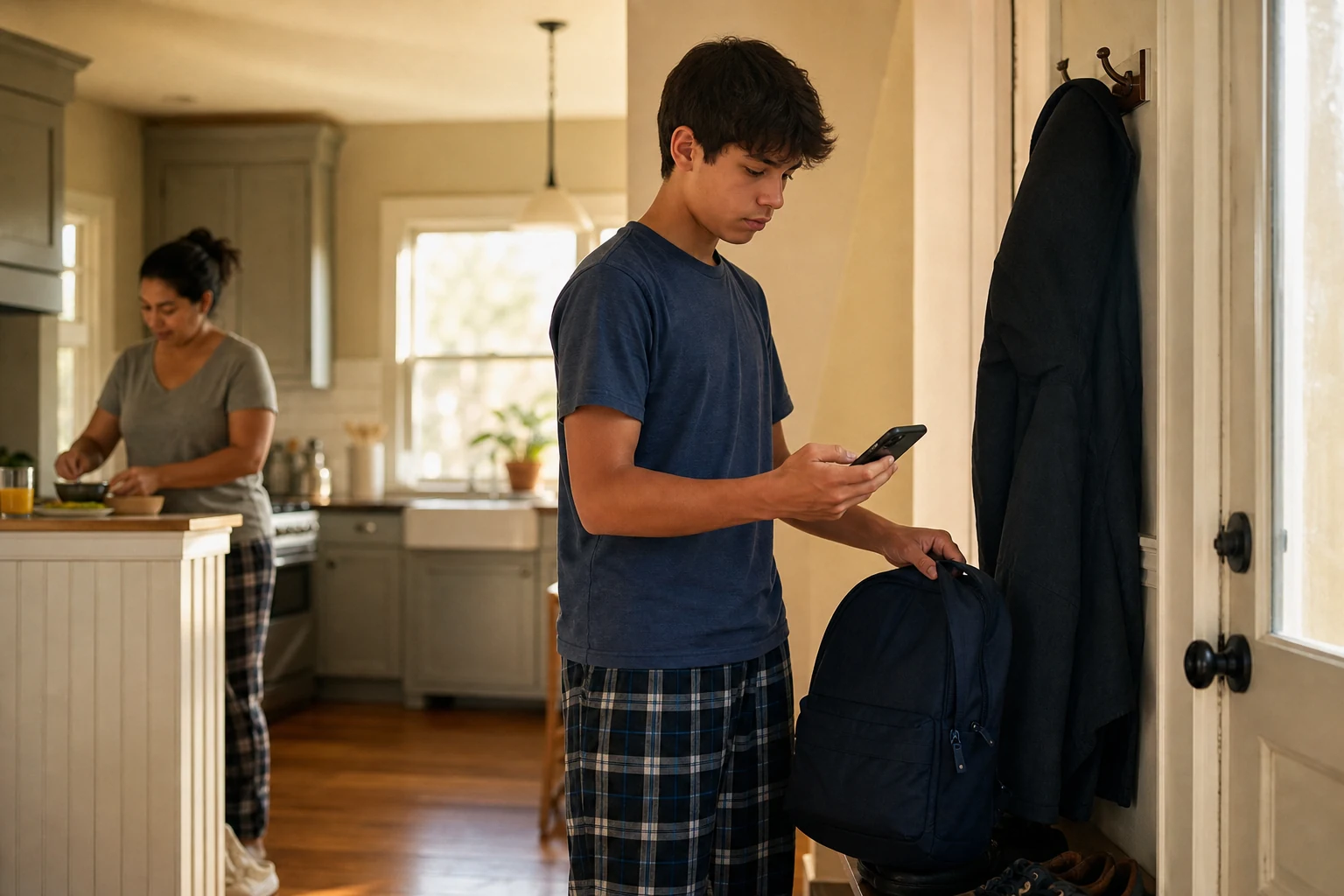
There is a particular kind of morning argument that can make a parent feel as if she has somehow become an emergency dispatch system.
You call upstairs. No answer.
You call again, louder. A foot thumps. “I’m up.”
Ten minutes later, he is still under the blanket, the bus is getting closer, and suddenly you are deciding whether to rescue him, lecture him, drive him, email the school, or let him face the result.
By the time everyone gets out the door, nobody feels more capable.
For boys in the early teen years, waking up is rarely only about an alarm. It can touch sleep, growing independence, school logistics, family stress, executive-function skills, and the question beneath many parenting conflicts: Which parts of this life are mine to manage, and which parts are his to learn to manage?
The answer is not “make him do everything alone.” Nor is it “keep waking him forever because the stakes are real.”
A more useful goal is to transfer a specific responsibility in a way that is planned, survivable, and reversible when adult support is genuinely needed.
Start with the right question
Instead of asking, “Why can’t you just get up?” try:
“What would need to be true for you to own getting up on school days?”
That question changes the assignment. You are not testing whether he is a good kid, grateful kid, or naturally organized kid. You are building a system.
The American Academy of Sleep Medicine recommends that teens ages 13 to 18 get 8–10 hours of sleep regularly. The American Academy of Pediatrics also notes that adolescence commonly brings a later shift in sleep timing. That does not mean every late night or missed alarm is unavoidable. It does mean that “just go to bed earlier” and “just get up” may be too small an explanation for a real morning problem.
Before you hand over the alarm clock, look at the conditions around it:
- What time does he actually need to be out of bed?
- What time is he usually asleep—not merely sent to his room?
- Does he have a reliable alarm he can hear and reach?
- Is his phone charging across the room, or under the pillow with notifications going all night?
- Does he know the bus time, ride plan, school start time, and the realistic time needed to get ready?
- Is there a reason he needs adult assistance in the morning?
This is not an interrogation. It is a setup conversation. Independence works better when the task is visible.
Try the Alarm Handoff: launch, log, repair, re-release
The Alarm Handoff is a release mechanism for a responsibility that has quietly belonged to the parent. Its purpose is not to see whether your teen fails. Its purpose is to let him practice ownership while keeping the family out of a daily power struggle.
1. Launch a small, explicit agreement
Choose a calm time—not while someone is half-dressed and late.
Name the handoff plainly:
“Starting Monday, you are in charge of waking yourself, getting dressed, and being ready to leave by 7:35. I will not do repeated wake-ups. Let’s set up what you need before we start.”
Then decide the practical details together:
- alarm time and backup alarm time;
- where each alarm will sit;
- clothes, bag, lunch, sports gear, and charger placement;
- the family’s departure time;
- what happens if he misses the bus or is not ready.
Keep the first agreement narrow. “Own your whole life” is not a task. “Wake, dress, pack, and be at the door by 7:35” is.
The adult can still own what is actually adult-owned: providing reasonable access to an alarm, a safe sleeping space, food, transportation information, school communication when needed, and any agreed accommodations. Transfer responsibility; do not quietly remove the tools required to carry it.
2. Log the outcome without turning it into a trial
For the first two weeks, treat mornings as information.
A simple shared note can be enough:
- Up by planned time: yes/no
- Ready by departure: yes/no
- What got in the way, if anything?
- What change will we try tomorrow?
This is not a behavior chart for public display, and it is not evidence for a closing argument. It is a way to replace “You never get up” with something more usable: “Three mornings worked. On the two that did not, the phone alarm was silenced and the bag was not packed.”
If he gets up and leaves on time, resist the urge to add a speech. A brief “You handled it” is enough.
3. Repair the system after a miss
A missed alarm is inconvenient. It may create a natural consequence: a rushed breakfast, a missed bus, a late arrival, or needing to use money or time to solve a transportation problem.
But a natural consequence is not the same as abandonment, humiliation, or a day-long lecture.
When everyone is calm, ask three repair questions:
- What happened?
- What part of the system failed?
- What is your next adjustment?
The adjustment should be concrete. Maybe the alarm moves across the room. Maybe a second alarm is added. Maybe the backpack is packed before screens. Maybe bedtime, activities, transport, or a morning medication routine needs a different plan.
Your job is not to supply every answer. It is to make sure a next experiment exists.
A script can help:
“I’m not interested in blaming you. I am interested in whether your plan got you where you needed to be. What do you want to change for tomorrow?”
That is different from pretending the outcome does not matter. School and commitments matter. The repair conversation simply keeps the focus on capability rather than shame.
4. Re-release after a short scaffold
Sometimes the first handoff is too large. That is useful information, not proof that your teen is incapable.
If there are repeated misses, add a short, stated scaffold rather than returning indefinitely to repeated nagging. For example:
“For the next five school days, I’ll do one check-in at 6:45. You still set both alarms, get dressed, and get to the door. We’ll review Friday whether the check-in can come off again.”
The check-in has a start date, an end date, and a purpose. It is not a permanent rescue service.
Then re-release it.
That last step matters. A temporary support can become a family role quickly: parent as waker, teen as woken. The point of a scaffold is to give the skill another practice runway, not to quietly take the job back.
When an adult should step back in
Giving back the alarm clock does not mean withholding support that protects safety, access, or health.
Step back in—and make a fuller plan—when any of these are true:
- Your teen has a disability, health condition, medication routine, individualized education plan, 504 plan, or other accommodation that requires adult morning support. That support is access, not “overhelping.”
- He cannot safely get to school or home if he misses the plan. For example, there is no safe transportation alternative, he would be stranded, or driving while severely sleepy is a concern.
- Waking difficulty is new, extreme, or paired with concerning changes in functioning. Bring those observations to an appropriate health professional rather than trying to solve them through stricter alarms.
- School avoidance, distress about school, bullying concerns, panic, family crisis, or another unresolved school-level issue appears to be driving the morning problem. Contact the school and relevant supports; an alarm plan cannot solve a problem it did not create.
- Attendance or tardiness is becoming a pattern. The U.S. Department of Education typically defines chronic absenteeism as missing 10% or more of school days for any reason—about 18 days in a school year. Do not wait for that line if the pattern is building. Contact the school early to agree a re-entry plan: who you will notify before the school day when possible, how your teen will get in safely after a late arrival, what attendance or wellbeing staff should know, and when you will review whether the plan is working.
These are not loopholes in independence. They are the conditions that make a responsible handoff possible.
Let the goal be ownership, not a perfect morning
Your son may still oversleep sometimes. So may you.
The longer-term win is not a spotless record of alarms. It is a teenager who can notice a problem, use available supports, repair a plan, and gradually carry more of the work of getting himself where he needs to go.
You can be warm without becoming the alarm clock.
You can hold the line without making a missed morning mean something cruel about him.
And when he is ready, you can hand back one small but important piece of his own life: the moment he wakes up and begins it.
PARENT ACTION
What to return to your teen
Alarm Handoff: launch an explicit agreement, log outcomes, repair the system after a miss, then re-release after a short scaffold.
PARENT GROWTH NOTE
One useful guide when it matters.
Get practical Parent Growth guides in your inbox. No noise, no pressure, and you can unsubscribe anytime.