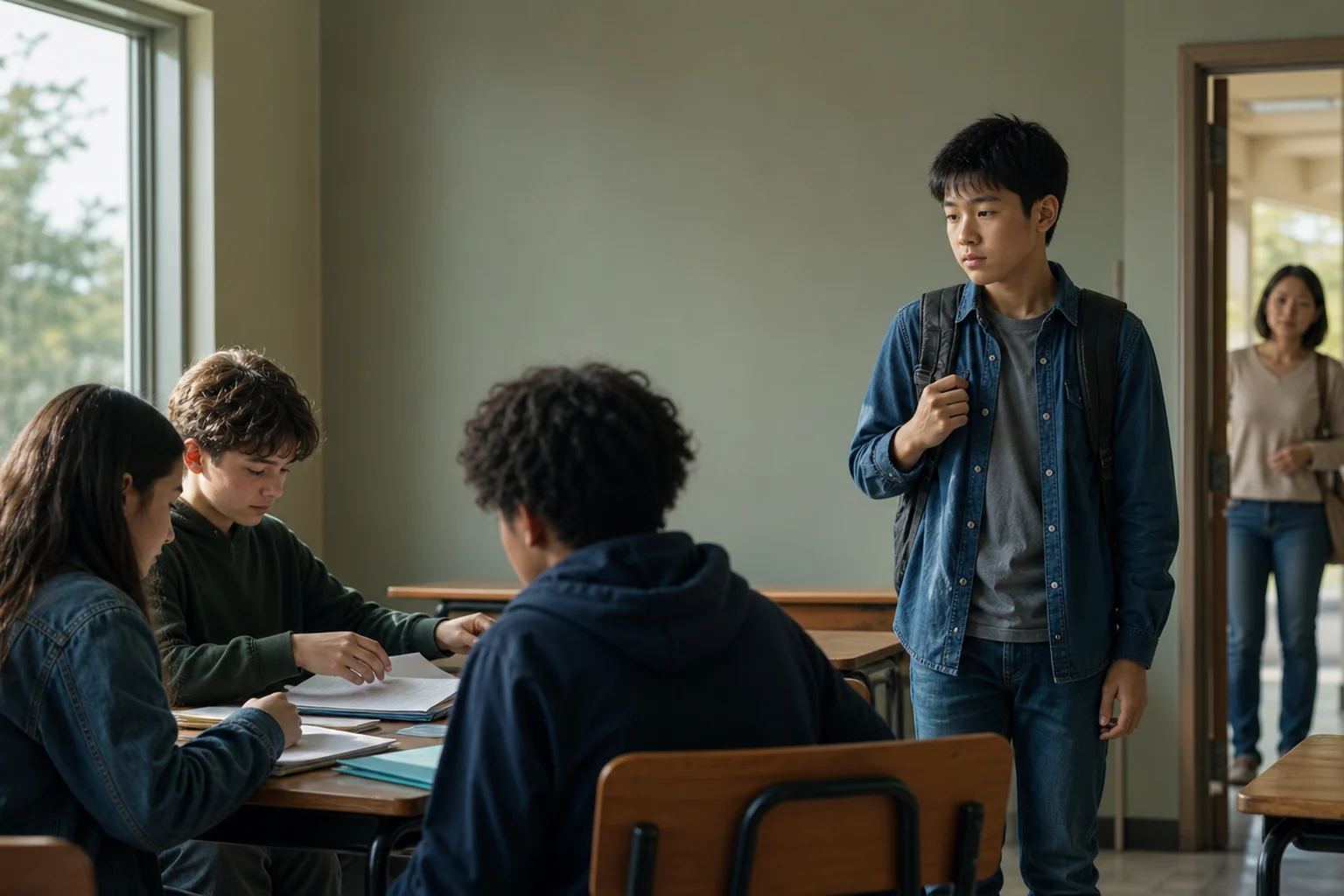
Your teen may know the answer, finish their part at home, and still go quiet when the class is told to “get into groups.” By the time they have worked out where to sit or what to say, louder classmates may have taken the roles, chosen the topic, or moved on.
That does not mean your teen is lazy, incapable, or socially broken. Group work asks for two jobs at once: do the schoolwork and enter a fast-moving social moment. A quiet teen may need a smaller way in—not a lecture about being more confident.
This guide has one narrow job: help your teen prepare one entry line, one useful contribution, and one recovery move for the next group task. It is not about making them the loudest person in the room.
Start with the moment, not a label
Ask about the sequence, not their personality:
“When the teacher said ‘find a group,’ what happened next?”
>
“Was the hard part choosing people, getting a word in, or knowing what job to take?”
>
“Do you want to work out one smaller move for next time, or leave it alone?”
That last question matters. Your teen may be content with a quiet role. Or they may want more room in the group but not know how to claim it without feeling awkward.
Avoid questions that turn one class into a verdict:
- “Why do you never speak up?”
- “You have to be more outgoing.”
- “Those kids are excluding you.”
- “Just put your hand up.”
You do not have enough information to decide any of those things. You do have enough information to help with the next practical step.
Use RESET → NOTICE → INVITE → RETURN
Before you rehearse a line, use this four-step parent rhythm. It keeps the conversation useful without making your teen feel watched.
RESET the pressure
Do not start in the school carpark with, “Did you talk today?” Wait until the ordinary landing time: after a snack, while packing a lunch, walking the dog, or when homework is already open on the table.
Try:
“You don’t have to give me a report. I noticed group projects can get hectic. Want help with one small part, or not today?”
"Can we talk about the next project for two minutes, then leave it there?"
"I notice you can explain the work well at home. I’m curious about the group part."
If they say not today, accept it. You are keeping the door open, not collecting proof.
NOTICE the exact sticking point
One group task can go wrong in different places. A teen may be fine explaining a science result but freeze while choosing a table. They may join a history group easily but lose their chance to speak when the shared slides are being divided. They may know the maths answer but not know how to interrupt three classmates already talking.
It may also land on a busy day: a morning rush, a phone message from a friend, a worry about grades, unfinished homework, a study deadline, a messy room, a missed chore, or a looming curfew. Those details do not explain the silence. They simply help you keep one difficult class from becoming a story about your teen’s whole life.
Ask one factual question:
“Was the hard bit finding a group, getting a turn, or choosing a job?”
“Did the group already have a plan, or did nobody know where to start?”
“Was there a part of the homework you could have owned if the opening had been easier?”
"What do you think would make the first thirty seconds easier?"
INVITE one small practice move
Ask permission before offering a script:
“Want one line ready for next time, or do you want me just to listen?”
"One option is to ask which part still needs doing."
"How about we practise that once?"
Choose a line that matches the moment. A teen entering a new group might ask for a place; a teen already seated in the group might ask which job is open. Keep it to one line and practise it once across the kitchen bench or on the walk to school.
RETURN after the next task
Do not grade the outcome by whether your teen made friends or spoke the most. Return to the information:
“Did the line fit the moment, or would you change it?”
“What part worked even one percent?”
“Do you want to keep that move, try a smaller one, or drop it?”
That is how a practical skill becomes theirs rather than another parent project.
The boundary is still clear: group work needs an honest attempt. The limit is one small move, not a forced performance or a consequence for being quiet.
Research shows that group tasks work best when the work has enough structure for each student to make a real contribution. That does not mean every teacher can change a group in the moment; it is a reason to ask for a clear first role when your teen wants that support.
Use the E–C–R plan: enter, contribute, recover
Keep the plan small enough to use under pressure.
1. ENTER with one ordinary line
Your teen does not need a clever opening. They need a line that gets them physically and academically into the work.
Pick one:
“Have you got room for one more?”
>
“Which part still needs doing?”
>
“I can take the first question if that helps.”
Practise it once at home. Do not turn the practice into a performance review. The point is to make the words familiar before the classroom gets noisy.
If groups are assigned, the entry line changes:
“What are we doing first?”
>
“Do you want me to find the examples or make the slides?”
A small, work-focused opener is often easier than trying to start a social conversation at the same time.
2. CONTRIBUTE one visible piece
“Say more” is not a usable instruction. Help your teen choose a contribution they can point to.
For a reading or history task, that could be:
- finding one quote or source;
- writing the group’s first two points;
- asking, “What is our main answer?”
For science or maths, it could be:
- checking one calculation;
- drawing the diagram;
- explaining one step back to the group.
For a presentation, it could be:
- building one slide;
- writing the opening question;
- offering to read one short section with a partner.
The goal is not to take over. It is to make their thinking visible before the group has silently decided they have nothing to add.
A useful sentence stem is:
“I think we could ___ because ___.”
Even if someone chooses another idea, your teen has practised entering the academic conversation. That is a better target than demanding that they become instantly relaxed.
Help them ask for structure, not rescue
Good group work needs more than putting students at the same table. Classroom guidance commonly recommends clear roles, smaller groups, and tasks where each person has a meaningful contribution. Teachers can often make that structure easier without singling your teen out.
If this happens repeatedly and your teen wants help, encourage them to ask the teacher privately before class:
“I’m okay doing group work, but I sometimes take too long to get started when groups form. Could I have a role to begin with, or know my group a little earlier?”
If speaking to the teacher feels too hard, a parent can send a short, proportionate note:
“My teen is working on taking a more active role in group tasks. They do not need special treatment, but if you notice a natural way to give the group clear roles or a defined first task, that structure would help them practise contributing.”
Do not ask the teacher to arrange friends, make classmates include your teen, or explain your teen’s personality to the class. Ask for a workable classroom structure and let your teen own the next move.
RECOVER after an awkward start
Sometimes the group is already full. Sometimes someone talks over them. Sometimes they miss the opening and feel like the whole task is ruined.
Give them a recovery line:
“I missed the start—what can I take from here?”
>
“Can I do the sources or the final check?”
>
“Could someone quickly tell me the plan?”
This is not a magic line that guarantees a kind response. It is a way to keep one awkward moment from becoming a reason to disappear for the rest of the task.
At home, debrief without turning it into an interrogation:
“What part worked even a little?”
>
“What would you keep the same next time?”
>
“Do you want one different line ready for next class?”
One small repeatable action is enough. Confidence often follows evidence that you can take part, not a parent’s instruction to feel confident first.
When to step back—and when to look closer
Step back if your teen can complete group tasks, seems comfortable with their level of involvement, and does not want coaching. Quiet participation is still participation.
Look more closely if the pattern lasts for weeks, causes clear distress, or interferes with school attendance, learning, friendships, or daily life. The National Institute of Mental Health advises seeking immediate help if a young person is unsafe or talks about harming themselves or someone else; contact local emergency or crisis support rather than treating this as a group-work problem.
Try this before the next group task
- Ask which part of group work is hardest: joining, speaking, or choosing a task.
- Agree on one entry line.
- Choose one visible contribution your teen could make.
- Keep one recovery line ready if the start goes badly.
- Afterwards, notice effort and information—not whether they became popular.
Your teen does not need to become someone else to work well with other people. They need a fair chance to enter the task, contribute something real, and try again after a clumsy moment.
If they want more practice with conversation, reading a group, and making a small contribution without performing, The Social Playbook can be an optional teen-owned tool—not homework and not a fix for being quiet.
PARENT ACTION
What to return to your teen
The parent helps prepare a proportionate first move and requests structure if needed; the teenager decides whether and how to use it.
PARENT GROWTH NOTE
One useful guide when it matters.
Get practical Parent Growth guides in your inbox. No noise, no pressure, and you can unsubscribe anytime.